Constraint as Catalyst: How Collaboration Unlocks the Work You Couldn't Make Alone
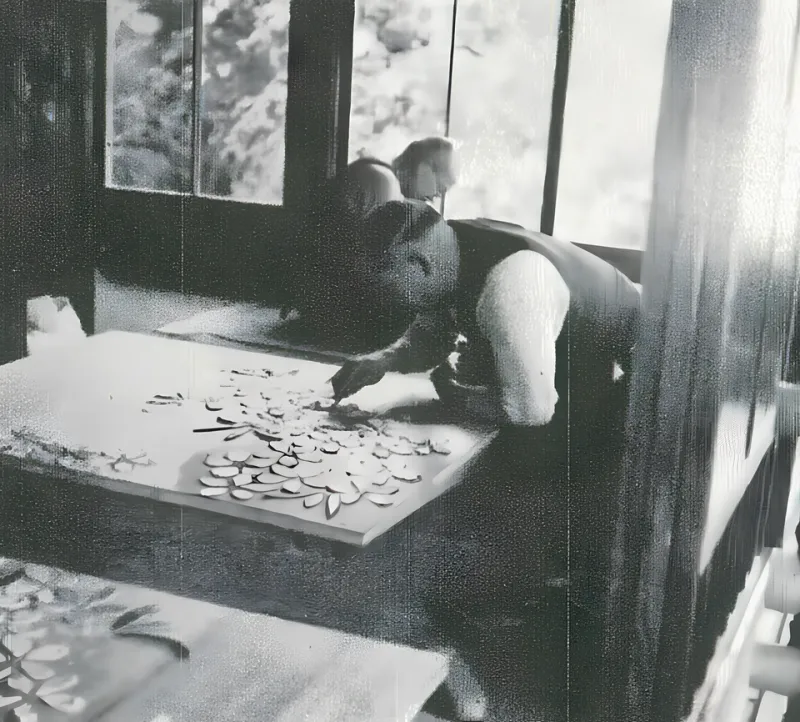
Photo: Rosanjin, Public domain, via Wikimedia Commons
There is a persistent myth in creative culture that the finest work is born from an unobstructed mind—an artist alone in a studio, answerable to no one, following instinct without interference. It is a romantic notion. It is also, in our experience, largely incorrect.
At Ostwald & Helgason, we have spent years examining what actually produces design that endures. The answer, time and again, points not toward freedom but toward friction. Not toward isolation but toward the productive tension that emerges when two perspectives, a client's requirements, and a finite set of resources are made to coexist in the same room.
This is what we have come to call the Collaboration Paradox: the conditions most likely to feel creatively limiting are, in practice, the conditions most likely to generate genuinely original work.
The Psychology of the Empty Canvas
Cognitive science offers a useful starting point. Research into what psychologists call "choice overload" consistently demonstrates that an excess of options does not liberate decision-making—it paralyzes it. The same principle applies to creative production. When the brief is entirely open, when the budget is uncapped, when no collaborator is present to question a direction, the designer faces the most daunting constraint of all: infinite possibility.
Infinite possibility, paradoxically, tends to produce conservative work. Without a boundary to push against, the creative mind defaults to what it already knows. It reaches for familiar aesthetics, proven structures, and comfortable references. The result is competent. It is rarely memorable.
Constraints change the equation entirely. A fixed color palette forces decisions about hierarchy and meaning that a full spectrum would never demand. A tight budget for a brand identity project compels a reduction to essentials—and essentials, stripped of ornamentation, are where visual clarity lives. A collaborator who disagrees with your initial direction forces you to articulate, defend, and ultimately refine the reasoning behind every choice.
Design History and the Productive Brief
This dynamic has precedent throughout the history of American design. Consider the work produced during the mid-century era of corporate identity—an era defined by strict brand standards, limited print production budgets, and highly prescriptive client relationships. The designers working within those structures did not produce diminished work. They produced some of the most iconic visual systems of the twentieth century precisely because every decision carried weight. Nothing could be arbitrary. Everything had to earn its place.
The Eames Office, perhaps the most celebrated American design partnership of the last century, operated under similar principles. Charles and Ray Eames were famously responsive to client constraints and manufacturing limitations. Their molded plywood furniture did not emerge from a fantasy of unlimited material options—it emerged from the specific challenge of bending wood to a human form within the tolerances of available industrial processes. The constraint was the design.
Collaboration between partners introduced an additional layer of productive limitation. Two distinct sensibilities, each with genuine authority, meant that no idea survived on personal preference alone. It had to hold up under a second perspective. That pressure is not a compromise of vision. It is a refinement of it.
How We Apply This at Ostwald & Helgason
Within our own practice, we have developed a deliberate approach to constraint-as-tool. Early in any engagement, we resist the impulse to begin generating concepts before the full scope of limitations is understood. What is the budget ceiling? What are the non-negotiable brand parameters? What has the client already tried and rejected? What does the partner bring to this project that differs from what I bring?
These questions are not obstacles to creativity. They are the architecture within which creativity becomes specific—and specificity is what separates design that resonates from design that merely functions.
We have found that the most productive phase of any collaboration is not the generative phase but the constraint-mapping phase. When both partners and the client sit together to define what cannot change, the space that remains—however narrow—becomes charged with creative possibility. You are no longer designing for anyone. You are designing for this problem, these people, this moment.
Harnessing Limitation Intentionally
For creative professionals looking to apply this framework in their own practice, the shift is primarily attitudinal. Rather than approaching a constrained brief with frustration, treat each limitation as a design prompt in itself. Ask: what does this constraint make possible that an open brief would not?
When a collaborator pushes back on a direction, resist the instinct to defend the original idea. Instead, ask what the pushback is revealing. Partner feedback, even when it feels imprecise or purely reactive, is pointing toward something real—a gap between your intention and the work's current ability to communicate it.
And when a client's requirements feel at odds with the design direction, consider that the client is not wrong about their needs. They may simply be articulating those needs imperfectly. Your role is not to override their constraints but to translate them into a design language that serves everyone in the room.
The Work You Couldn't Make Alone
The Collaboration Paradox resolves itself when you understand that originality is not a product of freedom. It is a product of engagement—with a problem, with a partner, with the specific and irreducible demands of a particular moment in time.
The work we are most proud of at Ostwald & Helgason did not emerge from our most open briefs. It emerged from the projects where the constraints were tightest, the partner dialogue most rigorous, and the client relationship most demanding. Those conditions did not limit the work. They made the work worth making.
There is a version of creative practice that treats collaboration as a necessary inconvenience—something to be managed on the way to executing a private vision. We would suggest a different orientation entirely: treat collaboration as the primary creative instrument. The constraints it imposes are not the price of working with others. They are the reason the work becomes what it could not have been alone.