The Productive Antagonist: Why Every Creative Partnership Needs a Dissenting Voice

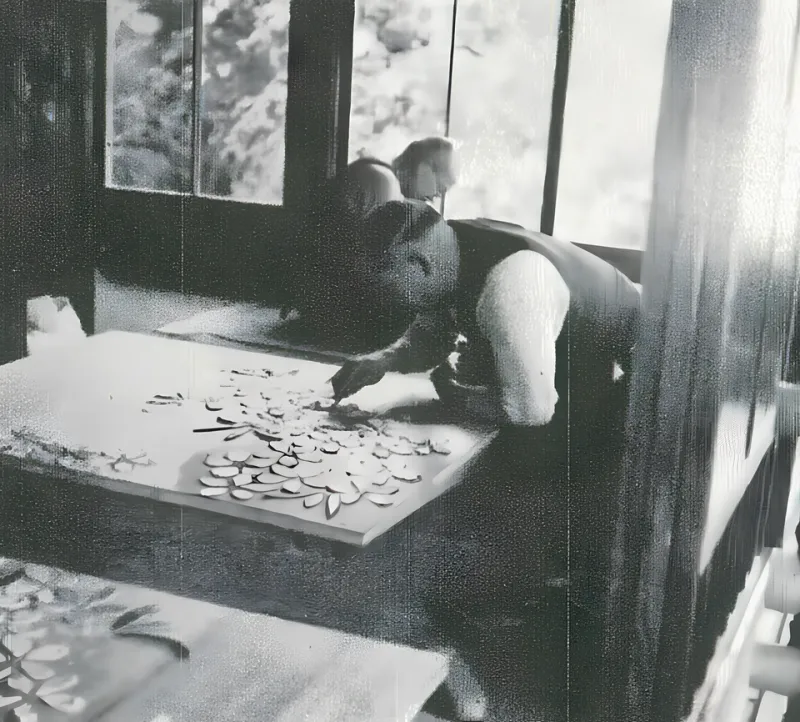
Photo: Lee Campbell leecampbell, CC0, via Wikimedia Commons
There is a particular kind of silence that settles over a creative meeting when everyone agrees too quickly. It feels, momentarily, like progress. Decisions are made. The path forward appears clear. But experienced designers and artists recognize that silence for what it often is: not consensus, but the absence of scrutiny. The work that emerges from such moments rarely surprises anyone — least of all the people who made it.
At Ostwald & Helgason, we have long held that the most durable creative work is forged through resistance, not accommodation. This is not a romantic notion about suffering for one's craft. It is a structural observation about how ideas are tested, refined, and ultimately made worthy of the audience they are meant to reach.
Opposition as a Design Tool
Consider the relationship between Charles and Ray Eames, whose mid-century furniture and film work defined an era of American design. Their partnership was not characterized by seamless agreement. Charles's architectural rigor and Ray's instinct for color, texture, and sensory experience were genuinely different orientations — and the tension between those orientations produced objects that were simultaneously functional and emotionally resonant. Neither perspective alone would have yielded the same result. The friction was not incidental to the work. It was constitutive of it.
More recently, the design world has observed similar dynamics in the long-running creative dialogues between art directors and photographers at major editorial institutions, where the best published work tends to emerge from genuine negotiation rather than deference. When a photographer insists on a visual approach that an art director initially resists, and when both parties have the professional security to hold their ground, the outcome is almost always more interesting than what either would have chosen independently.
This is what we mean by the productive antagonist: not an adversary, but a collaborator whose distinct perspective creates enough friction to demand that every decision be justified rather than merely accepted.
The Difference Between Friction and Dysfunction
It is worth being precise here, because the line between healthy creative tension and destructive conflict is real and consequential. Dysfunction in a creative partnership typically arises from personal grievance, unclear authority, or a fundamental mismatch in values. Productive friction, by contrast, operates at the level of ideas. It is impersonal, specific, and ultimately oriented toward the same goal: the integrity of the work.
Practically, this distinction means that a dissenting voice in a creative process must be legible as advocacy for the work rather than opposition to a person. When a collaborator challenges a typographic choice, a compositional decision, or a conceptual direction, the challenge carries weight only when it is accompanied by a clear articulation of what the challenge is meant to protect or improve. Criticism without direction is noise. Criticism with direction is design thinking.
Establishing this norm within a creative partnership requires deliberate effort. It means agreeing, early and explicitly, that no decision is above scrutiny — including decisions made by the more senior or more experienced partner. It means building a shared vocabulary for disagreement that keeps the conversation focused on outcomes. And it means cultivating enough mutual trust that a challenge to an idea is never received as a challenge to a person's competence or standing.
Frameworks for Inviting Dissent
For creative professionals seeking to introduce more productive friction into their practice, several approaches have proven consistently useful.
The designated skeptic. In any collaborative review process, assign one participant the explicit role of challenging the work. This person's job is not to be negative but to ask the questions the work has not yet answered. What assumption is this design making? What does it fail to account for? Who is it not speaking to? Rotating this role prevents it from becoming associated with any individual and keeps the scrutiny from feeling personal.
The alternative proposal rule. Any objection to a creative direction must be accompanied by at least one alternative. This transforms dissent from a veto into a contribution and keeps the conversation generative. It also forces the dissenting voice to put their own thinking at risk, which tends to sharpen the quality of the criticism.
The deferred consensus. When a creative team reaches agreement quickly, deliberately pause before finalizing the decision. Ask whether the agreement reflects genuine conviction or the path of least resistance. Sometimes the answer is conviction, and the decision stands stronger for having been tested. Sometimes the pause reveals that the agreement was premature, and the work benefits from a second pass.
What the Work Demands
The strongest argument for cultivating creative friction is not strategic. It is ethical, in the sense that the work itself makes a demand on the people responsible for it. Every significant design project — whether a visual identity, an environmental installation, a publication, or a digital experience — reaches an audience that will encounter it without the benefit of context. That audience will either be moved, informed, or persuaded by the work, or they will not. The process by which the work was made will be invisible to them.
This places an obligation on the makers. The comfort of the creative process is not a legitimate consideration when measured against the quality of the outcome. If introducing a dissenting voice into the work creates discomfort — and it will — that discomfort is precisely the mechanism by which the work becomes more than the sum of its makers' individual instincts.
At Ostwald & Helgason, we regard this not as a burden but as the defining condition of serious collaborative practice. The work earns its existence by surviving scrutiny. The partnership earns its longevity by making that scrutiny possible.